
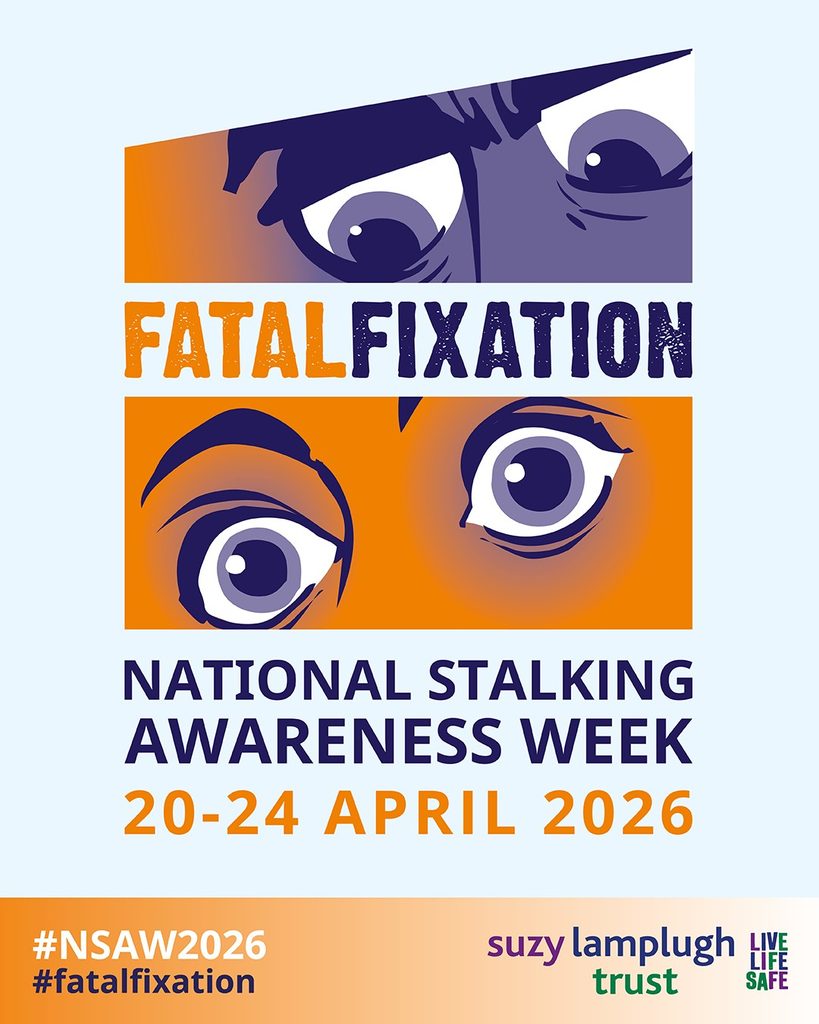
National Stalking Awareness Week 2026 takes place from 20-26 April. This year the Suzy Lamplugh Trust is highlighting the critical link between stalking and homicide, reinforcing the importance of early recognition and effective responses across all services.
Understanding Stalking
Stalking is a pattern of fixated, obsessive, unwanted and repeated behaviour, that causes fear, alarm or distress. Stalking can take many forms and there is no single checklist that captures every behaviour. However, examples may include:
- Regularly following someone or tracking their movements
- Persistent messages, calls or other forms of contact
- Repeatedly turning up uninvited at home, work, or public places
- Monitoring online activity or social media
- Sending unwanted gifts
- Identity theft such as signing up to services, buying things in someone’s name
It can be carried out by someone known to the victim, like a partner or an ex-partner, a work colleague, someone in the local community or a stranger.
Stalking and Domestic Abuse
Stalking is a high-risk behaviour and should always be taken seriously. It is closely linked to domestic abuse and often escalates following separation:
The following is taken from the Independent Domestic Abuse Services (IDAS) website:
“The decision to end the relationship can intensify the focus of the abuser, they risk losing control completely and may resort to extreme or persistent behaviours to try and regain control. This may involve emotional manipulation, begging for forgiveness, showering you with gifts and compliments, or promising to change their ways. This behaviour may manifest in stalking and harassment…”
IDAS also identify that the first six months after a relationship ends as the most dangerous, with the highest risk of serious harm and domestic homicide occurring during this time.
A free 35-minute webinar by IDAS on Understanding and Responding to Domestic Stalking is available to access during this week: Webinar: Understanding and Responding to Domestic Stalking
Training and development for NYC Officers
To support officers in developing a stronger understanding of how to assess risk in cases of high-risk domestic abuse, training sessions on Homicide Prevention and High-Risk Domestic Abuse will be delivered throughout 2026. Housing staff should not attend as other courses are specifically available.
Full details are available on the Learning Zone, and sessions will cover topics including:
- DA and homicide stats
- Risk assessments, high-risk indicators
- The 8-stage domestic homicide timeline
- Ending a relationship – A time of increased risk
For more information and to book a place please visit: Learning Zone
For information, advice and support contact:
Domestic abuse | North Yorkshire Council
Alice Ruggles Trust | Putting an end to stalking
As part of our commitment to raising awareness of all types of domestic abuse each month we will focus on one area and provide you with information and ways to access support, for you or anyone you know who may need it.



 View all our news